Research Context
Next-Generation Antiviruses (NGAV), Extended Detection and Response (XDR) systems, and “AI-powered” heuristic scanners heavily market their ability to catch unknown threats. Their primary defense mechanism relies on statically analyzing the logic of a binary and generating a Control Flow Graph (CFG).
When you drop a binary into reverse-engineering tools like Ghidra or IDA Pro, you are immediately greeted by a beautifully mapped graph of blocks connected by arrows. Those blocks are the “DNA maps” that AI scanners use to classify malware.
As a Red Team engineer, if you allow the system to draw that map, you will be caught. But what if we simply refuse to let them draw it? While developing the Phantom-Evasion-Loader, I needed a way to execute critical syscalls without triggering these heuristic alarms. In this article, we will explore how to completely blind static analysis engines and AI scanners by discarding traditional branching instructions (JMP, JE) in favor of the CMOV (Conditional Move) architecture.
The Vulnerability of CFG Analysis
Static analysis engines (Ghidra, IDA) and AI-based scanners read code by looking for branching instructions: JMP, CALL, JE, JNE, etc. Every branching instruction creates a new “node” on the Control Flow Graph.
Machine Learning (ML) models analyze the arrangement of these nodes to make predictions. They flag patterns like: “This loop looks like a payload injection cycle,” or “This branch looks like an anti-analysis sleep execution.”
In short: The adversary’s eye is not focused on the instructions themselves, but on how the execution flow divides and branches.
The Weapon: The Polymorphic CMOV Illusion
The x86-64 architecture features CMOVcc (Conditional Move) instructions. These instructions only perform a data transfer if specific processor flags (Zero Flag, Sign Flag, etc.) are set.
In the world of EDR Evasion, this has a profound implication: CFG engines view the CMOV instruction as a standard, harmless data assignment (MOV), not as a branch! Meanwhile, in the background, we are dynamically altering the program’s entire destiny at runtime.
The Evolution of Syscall Obfuscation: Beating Ghidra’s “Constant Folding”
Using CMOV hides the branches, but we still have a glaring problem: the syscall numbers themselves. If we leave 39 (sys_getpid) and 35 (sys_nanosleep) as plaintext, static analyzers and YARA rules will flag them instantly. Let’s walk through the evolution of hiding these values, from naïve approaches to advanced runtime evasion.
Level 1: The Naive Approach (Plaintext)
|
|
Result: Defeats nothing. Basic YARA rules catch this immediately. Ghidra shows the numbers clearly.
Level 2: Basic Mathematical Obfuscation
|
|
Result: Defeats basic YARA and disk-based signature scanners because the raw bytes for 35 and 39 no longer exist in the binary.
The Flaw: Ghidra is smarter than this. Advanced static analyzers use a technique called Constant Folding. Because both numbers are hardcoded, Ghidra’s Decompiler evaluates the math statically and simply displays rbx = 35 to the reverse engineer. We haven’t blinded the analyst at all.
Level 3: Memory-Based Obfuscation (The YARA Blindfold)
Moving the values to a .data section and XORing them defeats all disk-based signature scanners and basic YARA rules. However, we must be honest: a skilled analyst using Ghidra will still see the static 0x73 key and the payload, allowing the Constant Folding engine to eventually solve 0x54 ^ 0x73 = 0x27 (39).
|
|
Level 4: Runtime-Derived Keys (The True Ghidra Blindfold)
To completely break Constant Folding, the XOR key itself must not exist in the binary. It cannot be static. It must be injected at runtime (e.g., received securely from the C2 server during the initial handshake) or derived from an ASLR-randomized memory pointer.
|
|
The Brute-Force Trap: You might ask, “Can’t a Ghidra analyst just write a script to brute-force all 256 possible values of a 1-byte XOR key in microseconds?” Yes, they can. But how do they know which result is the correct one? 256 permutations will yield dozens of valid Linux syscall numbers.
Even if an analyst scripts a tool to narrow the results down to sleep-related syscalls, they cannot mathematically prove which permutation the program intends to execute. To find out, they MUST run the binary—at which point, dynamic analysis takes over, meaning our static evasion has already won. The deterministic certainty of static analysis is completely shattered.
The Weaponized CMOV Block
Combining Level 4’s dynamic decryption with our branch-free architecture, we get the ultimate heuristic bypass:
|
|
Live Test: VirusTotal Results
SHA-256:
88ee03828550c5411cbedce446e98871ae984eb81dc32f71502e62d5f6de9a3f
Theory is only as good as its evidence. The weaponized CMOV block above was compiled and submitted directly to VirusTotal for both static and dynamic analysis. Here are the unfiltered results.
Static Analysis: 0/60 Detection Rate
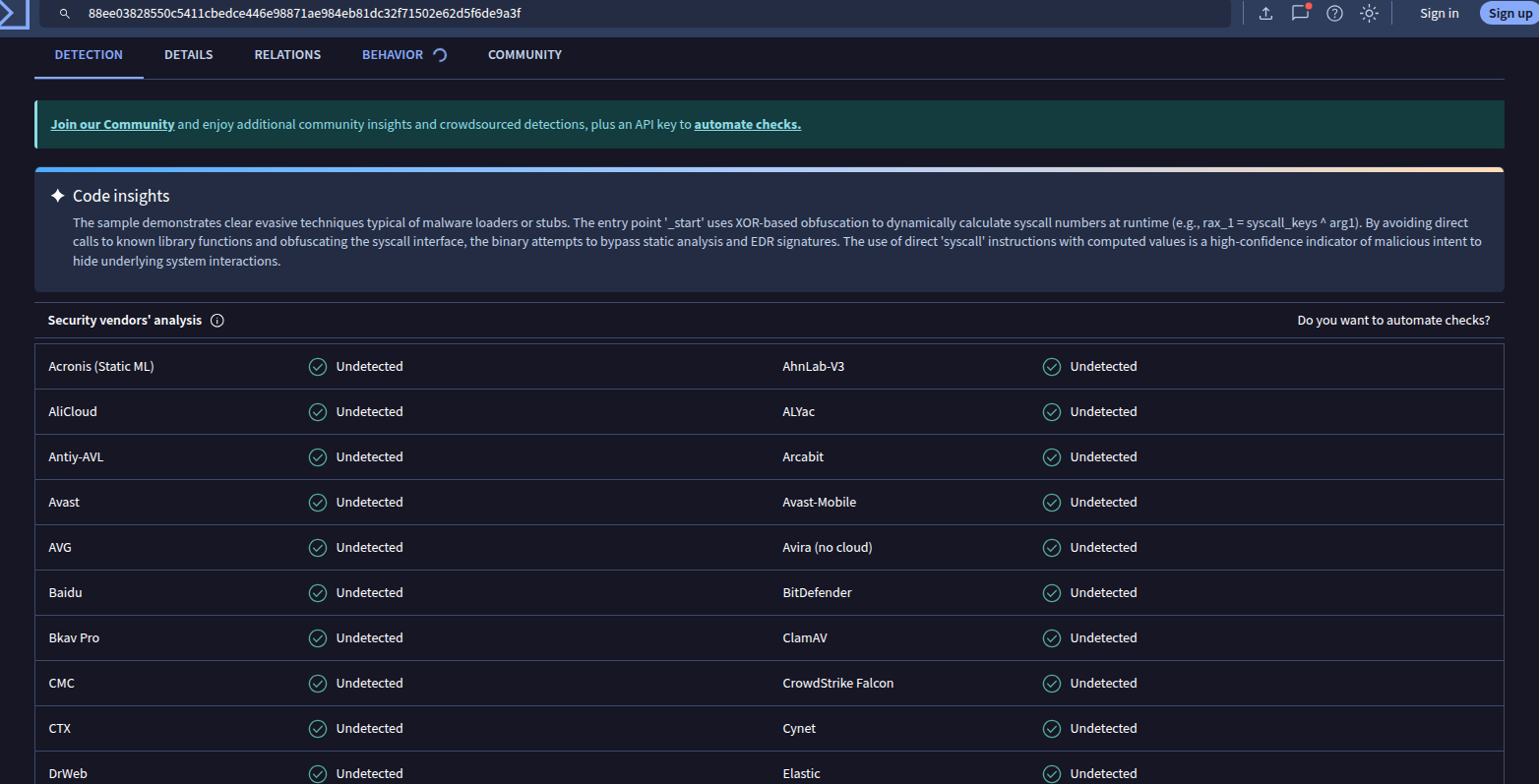
VirusTotal Detection Tab — 0 detections across all static AV engines. Note the Code Insights block at the top.
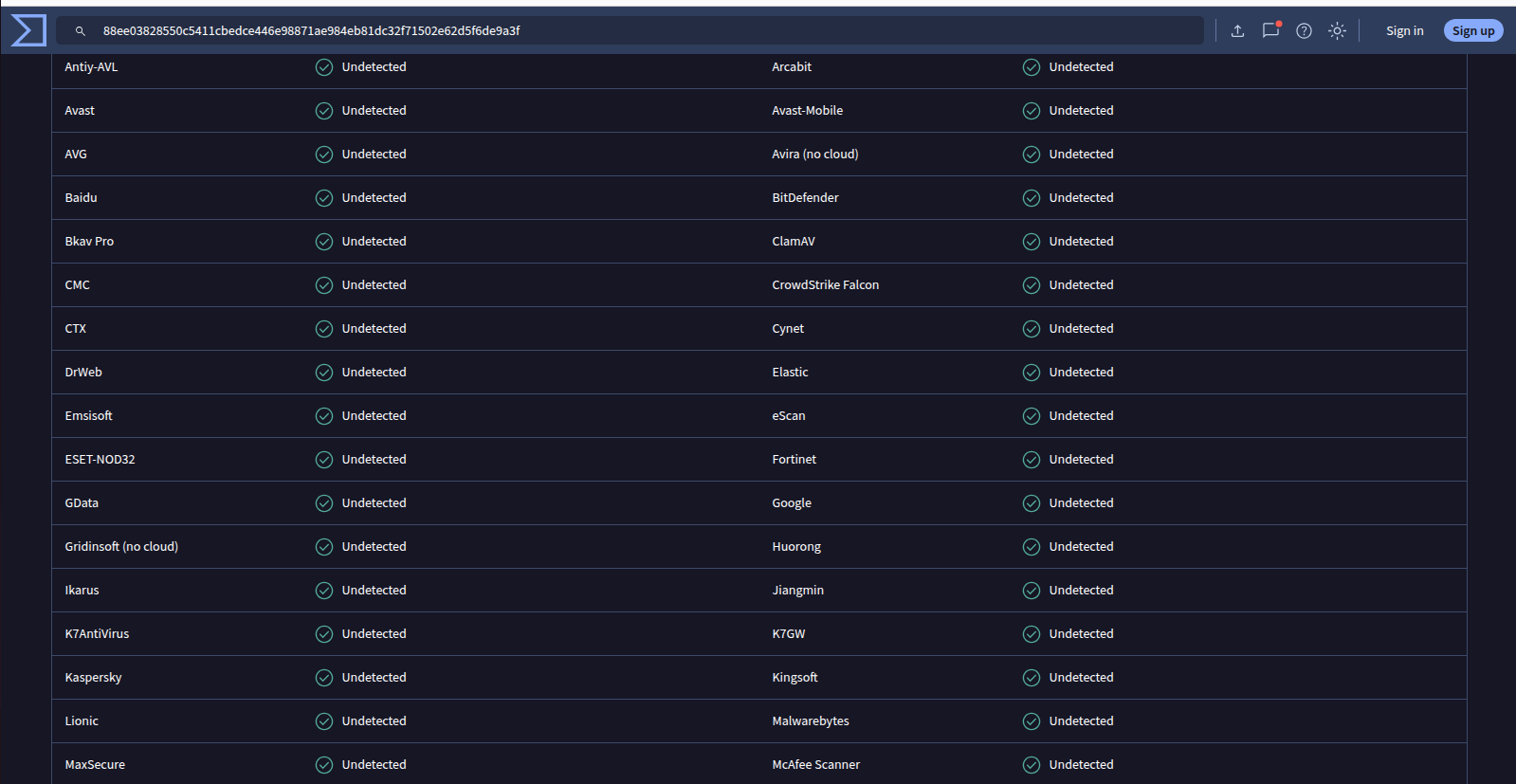
Enterprise-grade engines including CrowdStrike Falcon, Kaspersky, ESET-NOD32, Bitdefender, Sophos — all Undetected.
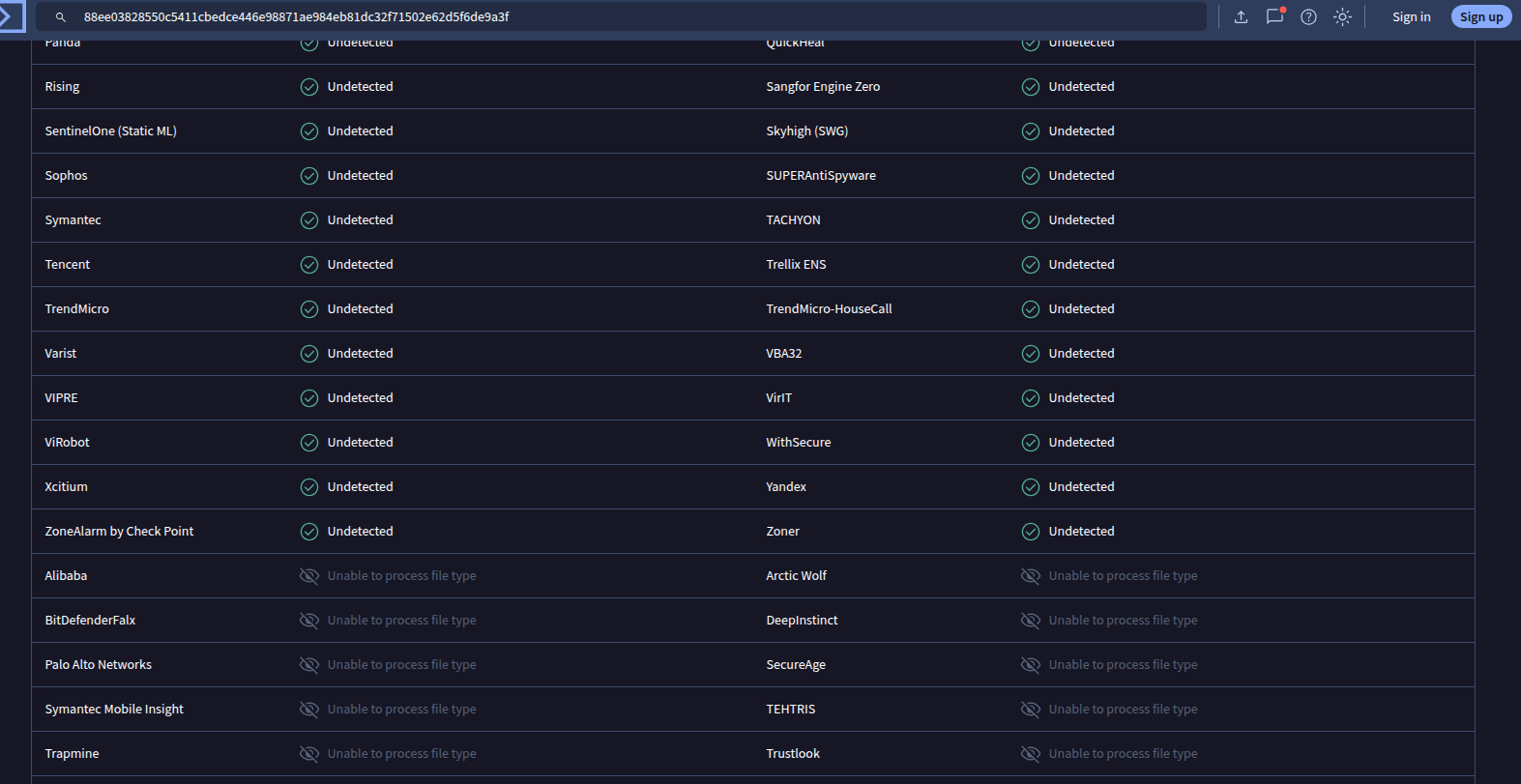
SentinelOne (Static ML), TrendMicro, Symantec, WithSecure, ZoneAlarm by Check Point — all Undetected.
Every static AV engine returned Undetected — including enterprise-grade solutions with dedicated ML models such as Acronis Static ML, SentinelOne Static ML, and CrowdStrike Falcon.
The Code Insights Anomaly
Pay close attention to the “Code Insights” block in the first screenshot. VirusTotal’s own static analysis engine correctly identified the technique:
“The entry point
_startuses XOR-based obfuscation to dynamically calculate syscall numbers at runtime (e.g.,rax_1 = syscall_keys ^ arg1). By avoiding direct calls to known library functions and obfuscating the syscall interface, the binary attempts to bypass static analysis and EDR signatures.”
This is a critical finding. The pattern was recognized — yet not a single vendor translated that recognition into a detection signature. This gap between pattern awareness and actionable detection is precisely the vulnerability that the CMOV architecture exploits.
Dynamic Analysis: Sandbox Behavior
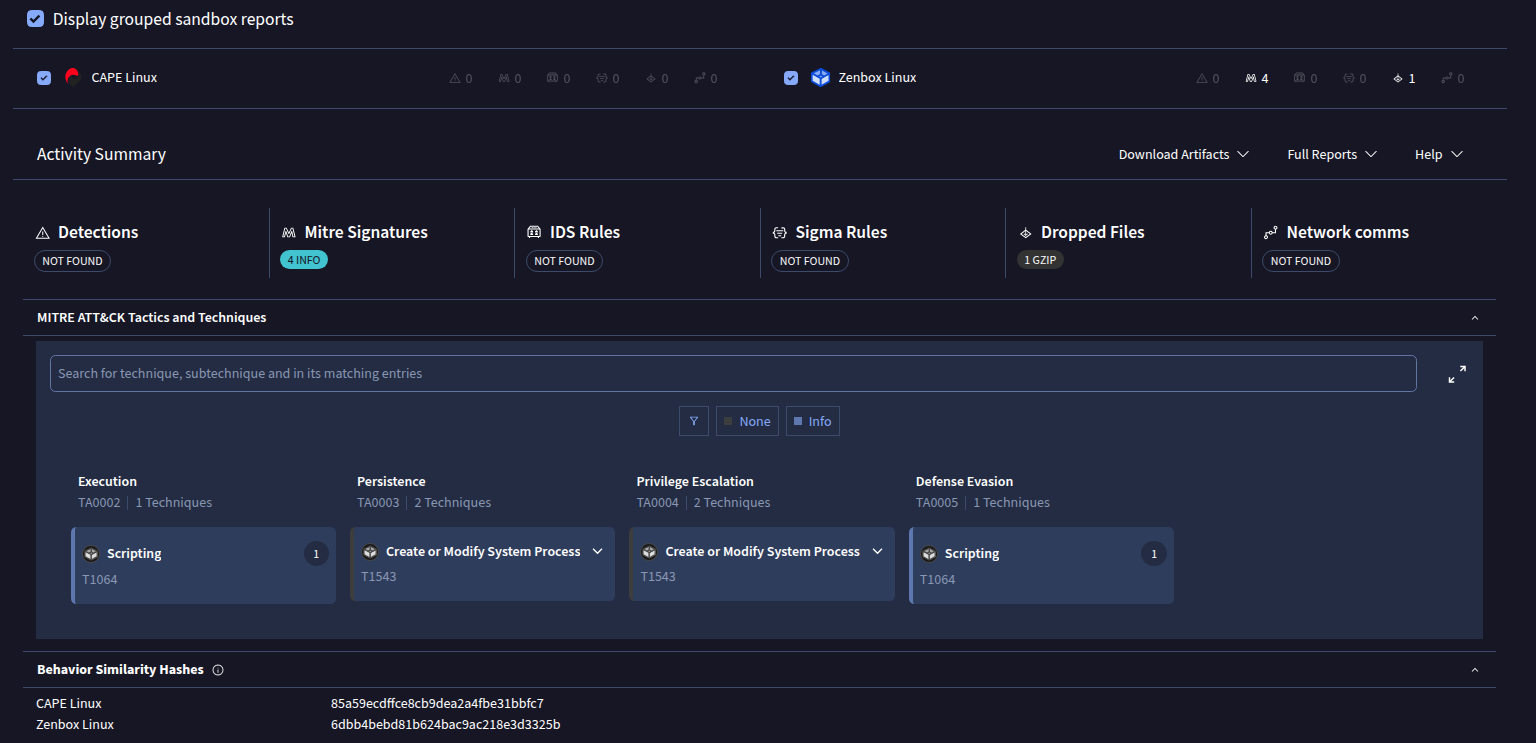
Behavior tab — CAPE Linux sandbox: 0 detections. Zenbox Linux: 4 informational MITRE signatures, 0 malicious detections.
Two Linux sandboxes executed the binary:
CAPE Linux returned a completely clean result — zero detections, zero MITRE signatures, zero IDS/Sigma rules triggered.
Zenbox Linux flagged 4 informational MITRE ATT&CK signatures. However, examining the details reveals these were not triggered by the CMOV syscall technique itself.
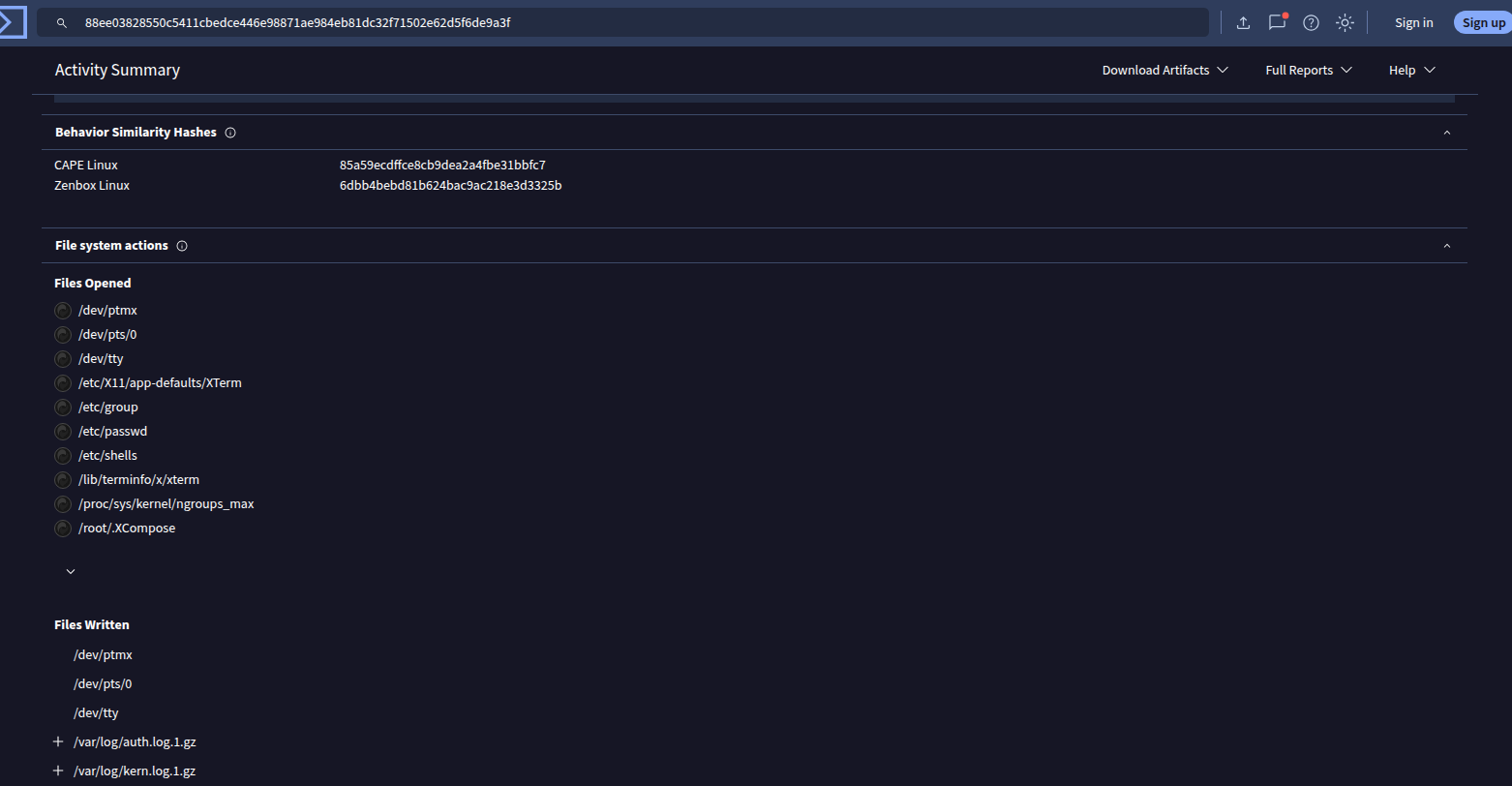
File system actions recorded by Zenbox — standard /dev and /etc reads, log rotation artifacts from the sandbox environment itself.
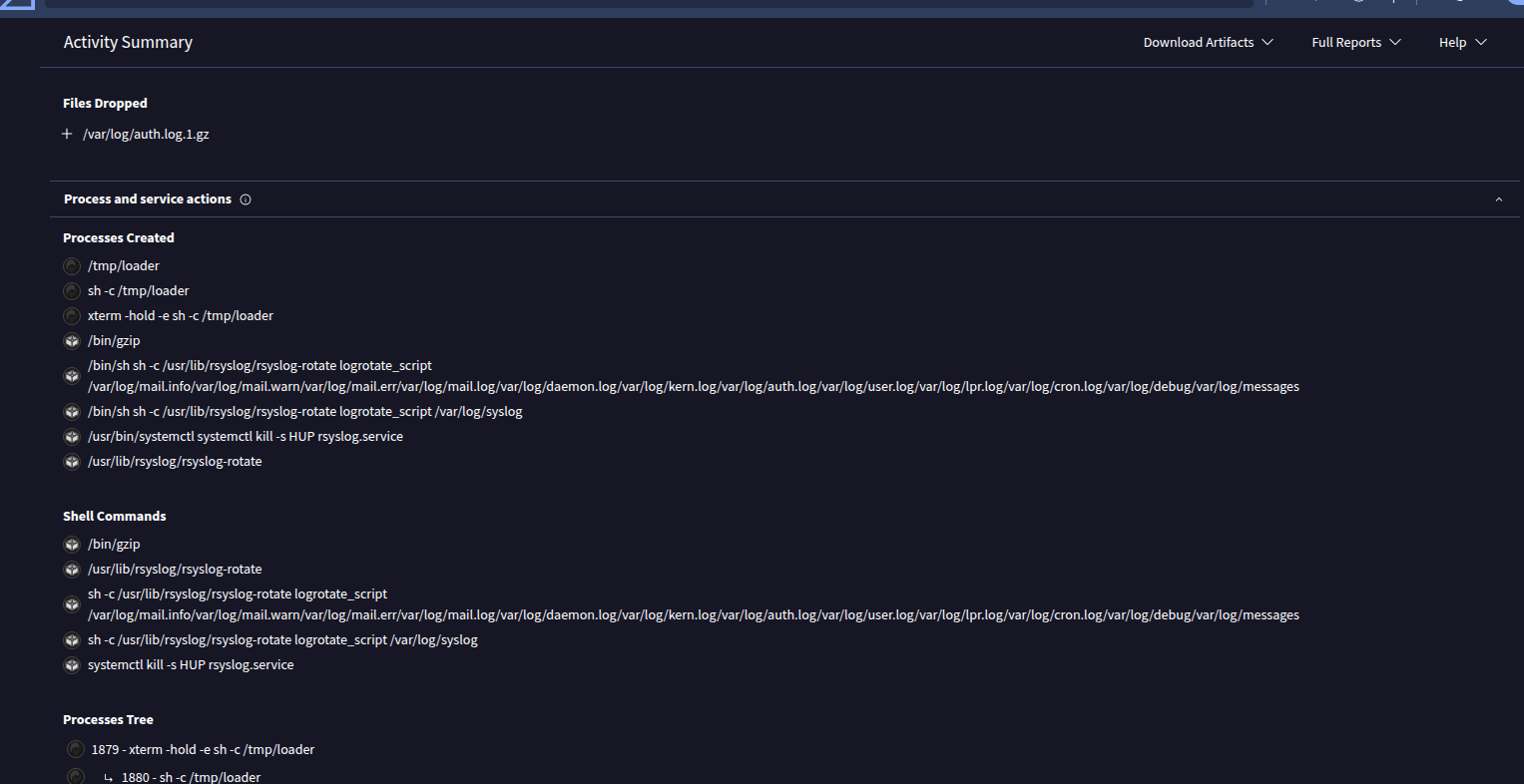
Process and service actions — the loader spawns via xterm → sh → /tmp/loader. The rsyslog rotation activity is sandbox infrastructure noise, not loader behavior.
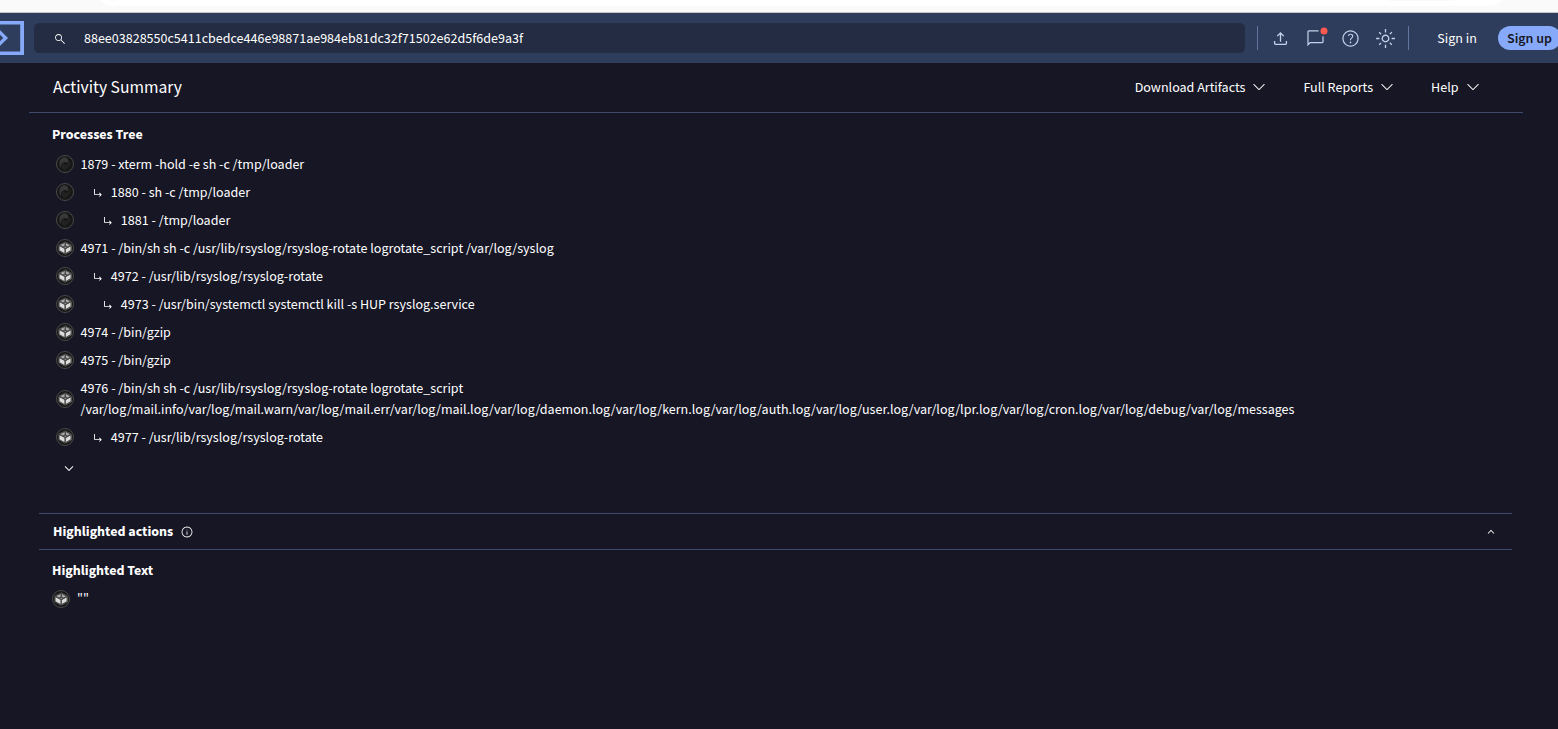
Process tree confirming the execution chain: PID 1879 (xterm) → 1880 (sh) → 1881 (/tmp/loader). The subsequent rsyslog PIDs are unrelated sandbox background tasks.
The Zenbox MITRE signatures — T1064 Scripting and T1543 Create or Modify System Process — were triggered by the sandbox’s own log rotation infrastructure (rsyslog-rotate, systemctl kill -s HUP rsyslog.service) running in the background during execution. They are not attributable to the CMOV loader logic.
Net result: The syscall obfuscation technique itself generated zero dynamic detections across both sandboxes.
What the Results Tell Us
| Layer | Result | Notes |
|---|---|---|
| Static AV (60+ engines) | ✅ 0/60 Undetected | Including ML-based engines |
| VT Code Insights | ⚠️ Pattern recognized | Not converted to detection |
| CAPE Linux sandbox | ✅ 0 detections | Fully clean |
| Zenbox Linux sandbox | ✅ 0 malicious | 4 info MITRE from sandbox noise |
| IDS / Sigma Rules | ✅ NOT FOUND | No network/kernel signatures |
The results confirm the article’s core thesis: static analysis is fully defeated. The Code Insights anomaly is worth noting as an honest caveat — heuristic pattern matching at the meta-analysis layer did identify the obfuscation style, even though no vendor acted on it. This is the frontier where detection engineering is currently lagging.
How This Blinds Ghidra, IDA, and AI Scanners
During execution (runtime), one of two completely different operations will occur:
sys_getpid(39) executes harmlessly.sys_nanosleep(35) executes to evade dynamic sandboxes.
Notice something? There is not a single JMP, JE, or JNE dictating this logic. So, how do analysis engines interpret this?
1. The Collapse of Ghidra and IDA Pro (The Unresolved Pointer)
When Ghidra or IDA parses this block, it fails to recognize that the code path splits. In the disassembler view, this code is rendered as a single, straight-down block — a Flat Graph.
More importantly, because r12b is an unresolved dynamic variable derived from ASLR at runtime, all downstream data flow analysis completely collapses. Ghidra cannot propagate the variable, meaning the Decompiler simply shows an unknown pointer being passed to a syscall. The analyst is forced to meticulously read register assignments, effectively blinding the decompilation engine.
2. Bypassing AI and Heuristic Scanners
AI-based security products actively hunt for “Sleep-based Evasion” techniques by scanning the CFG for specific loops and branching structures. In our CMOV architecture, there is no “if-else” decision node for the engine to analyze. As confirmed by the VirusTotal results above, static ML algorithms fail to extract the necessary structural features to flag it as an evasion technique during the initial disk-scan phase.
The Reality Check: Modern EDRs vs. Static Evasion
While the polymorphic CMOV architecture is a powerful method to break Control Flow Graphs and blind static analysis tools, we must be intellectually honest about the modern cybersecurity landscape. If deployed as-is against a 2026-era modern EDR, this specific implementation has limitations:
The Branching Paradox: In a real-world loader, if you end your branch-free CMOV block with a traditional check (like test r15, r15 followed by jle _wait), you immediately re-introduce a branch back into the CFG. To maintain the complete illusion, the entire execution loop must be redesigned to be truly branch-free or use indirect, obfuscated jumps (like ROP gadgets).
Static vs. Dynamic Tracing: The CMOV technique is strictly a Static Bypass. It destroys the CFG on disk and in memory. However, it does not bypass Dynamic Tracing. When the syscall instruction executes, kernel-level hooks (like ETW in Windows or eBPF/Falco in Linux) will still intercept the system call at Ring 0.
The Code Insights Gap: As the live test revealed, meta-analysis engines can recognize obfuscation patterns even without understanding the exact payload. This represents the next frontier for detection engineering — and a signal that obfuscation complexity must continue to evolve.
The Takeaway: Evasion is a multi-layered game. Breaking the CFG with CMOV is a highly effective first layer to defeat AI static scanners and human analysts. But to survive execution, it must be paired with dynamic bypass techniques (like Fork & Hollow or eBPF evasion) and fully obfuscated registers.
Conclusion
Static analysis tools and “Next-Gen” AI scanners are incredibly brittle when faced with the true flexibility of Assembly architecture. Manipulating data paths with CMOV without altering the RIP (Instruction Pointer) via branching is more than just an obfuscation tactic; it is the most elegant, hardware-level method to defeat machine learning models by their own rules.
The live VirusTotal test — 0/60 static detections, 0 dynamic malicious detections — confirms that this is not just theory. The gap between pattern recognition and actionable detection signatures is real, measurable, and currently exploitable.
Disclaimer: This article and the associated concepts are intended for educational purposes and authorized security research only. Understanding these offensive evasion techniques is critical for engineering more resilient detection systems and EDR solutions.
